


A bipartisan group of lawmakers said they were introducing legislation Thursday aimed at protecting American artificial intelligence companies like OpenAI and Anthropic from Chinese competitors.
Subscribe to read this story ad-free
Get unlimited access to ad-free articles and exclusive content.

The bill, called the Collaboration on Adversarial Threats and Security Risks Act, treats Chinese alleged copycats as a security threat to the U.S. and would create an exemption to antitrust laws so AI companies and industry groups can coordinate on a response, according to a summary of the legislation from the lawmakers’ offices. Antitrust laws generally limit intra-industry coordination on many subjects, on the theory that coordination may raise prices for consumers.
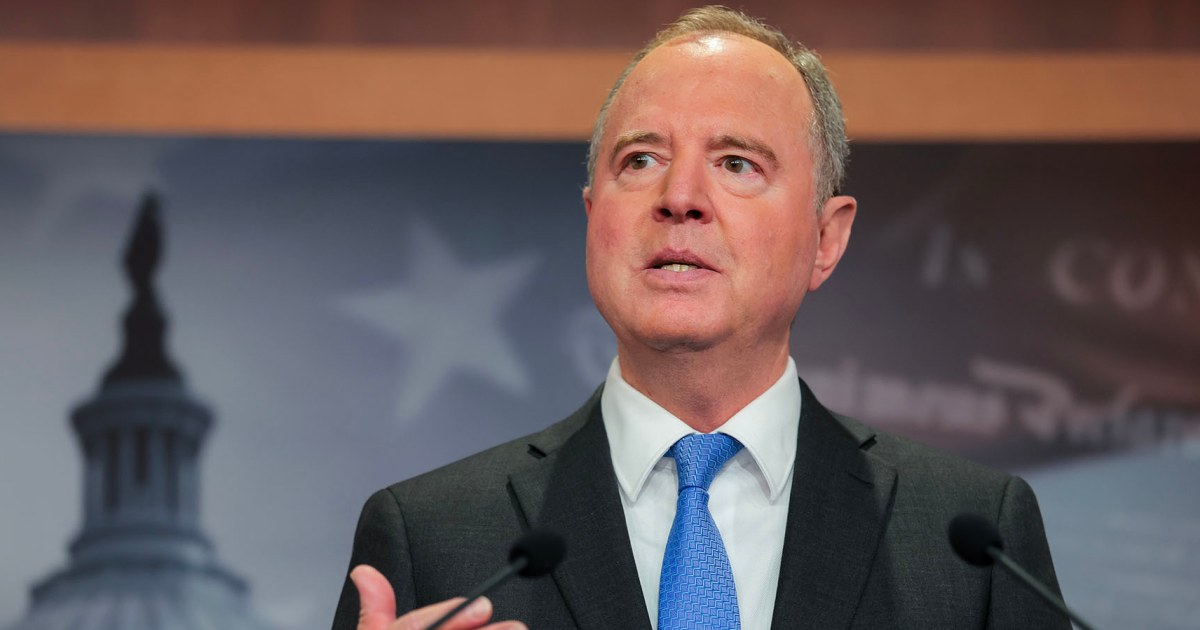
The legislation is being introduced by Sens. Adam Schiff, D-Calif., and Jim Banks, R-Ind., and Reps. Bob Latta, R-Ohio, and George Whitesides, D-Calif.
Lawmakers said the bill would allow AI companies and industry groups to share information related to certain security risks as long as they do so in good faith for the exclusive purpose of preventing, investigating or mitigating AI security risks. They could also coordinate — for the exclusive purpose of reducing AI security risks — by delaying or limiting the deployment of high-risk AI models, with required written notice before they take such actions, according to the summary of the legislation.
The lawmakers said their antitrust exemption would include strict guardrails to keep the AI sector competitive. They said their legislation would also permit the attorney general to seek an injunction against organizations that abuse the exemption.
It’s part of a wider effort by the U.S. government to protect the fast-growing AI industry from mounting Chinese competition. In recent weeks, several Chinese AI companies, including Moonshot and Z.ai, released new AI systems that appear to match leading American AI capabilities — a remarkable surge in Chinese AI performance.
Treasury Secretary Scott Bessent threatened in an interview Tuesday with Fox Business to sanction “overseas models” for “stealing from our great companies.” He repeated the threat Wednesday, saying on X that sanctions were “on the table.”
Michael Kratsios, director of the White House Office of Science and Technology Policy, separately accused Moonshot of “stealing proprietary U.S. technology” Wednesday on X. Moonshot did not respond to a request for comment.
Anthropic, Google and OpenAI are increasingly complaining about what’s known in the tech industry as “distillation”: submitting thousands or even millions of queries to an advanced AI model and processing its outputs in an attempt to improve an inferior AI model and create, in effect, a less expensive knockoff.
China has rejected allegations that it is stealing American trade secrets, calling them an unfounded smear.
“China has consistently attached great importance to the protection of intellectual property and is committed to safeguarding, in a fair and impartial manner, the lawful rights and interests of both domestic and foreign IP holders,” Liu Chang, a spokesperson for the Chinese Embassy in Washington, said in a statement Wednesday.
“China’s development is driven by its own sustained efforts and has also benefited from mutually beneficial international cooperation,” he said. “Relevant individuals in the United States should respect the facts, discard prejudice, and stop smearing and discrediting China’s achievements in the development of its artificial intelligence industry.”
The U.S. lawmakers said they believe that the threat is real and that AI firms need to be able to share information to counter it.
“We cannot allow China, or any foreign adversary, to steal American technological advancements in AI, and then weaponize those advances to undermine our own national security,” Schiff, whose state is home to the leading U.S. AI labs, said in a statement.
“As new AI innovations are developing faster than ever, it’s critical that Republicans and Democrats continue to work together to address potential misuse of AI development by hostile actors at home and abroad,” he said.
Latta, chair of the House Energy and Commerce subcommittee on energy, said AI models are now critical infrastructure like the electric grid.
“Protecting the American people means ensuring the systems they rely on every day, including our hospitals, water systems, and electric grid, remain safe, secure, and reliable,” he said in a statement. “Our adversaries are constantly looking for new ways to target our critical infrastructure, and we must make sure we are prepared to respond.”
Antitrust laws limit coordination within an industry so businesses can’t agree to fix prices, divvy up territory or otherwise restrain trade. But Congress has on occasion expressly created exemptions when it has identified national security interests, as it did in 2015 when it passed an exception related to cybersecurity information-sharing.
The Justice Department’s Antitrust Division also has the authority to grant temporary or limited exemptions for businesses to coordinate, a power it used in 2020 to allow vaccine makers to share information early in the Covid-19 pandemic.
But within the tech industry, the value of distillation is hotly disputed, especially as customers face big bills from the leading U.S. AI labs. Arguing in favor of using low-price Chinese models, Nic Carter, a Miami-based venture capitalist, said in a widely shared post on X this week that American businesses and consumers “will benefit from hyperdeflation in the cost of digital cognition just like everyone else.” Another venture capitalist, Bill Gurley, said on X that AI firms should sue, rather than lobby the government, if they think their work is being unlawfully infringed upon.
Some U.S. companies have been vocal in their defense of using foreign AI models. Hugging Face, which makes software used by AI labs, said last week that it turned to a Chinese model to successfully analyze a large-scale cyberattack after “frontier models” from the U.S. were no help. On Tuesday, OpenAI revealed in a blog post that one of its autonomous agents was behind the hack after it went rogue.
Clement Delangue, the CEO of Hugging Face, praised distillation on X in April.
“What people call ‘distillation’ is a super common practice (you use other models to benchmark your model, to evaluate your inputs or to add a little bit to your datasets) that in my opinion should be covered by fair use (just like using public data is), especially when the resulting models are open-source as it benefits all and helps break out monopolies that are strongly forming in AI!” he wrote.
SpaceX CEO Elon Musk testified in April as part of his lawsuit against OpenAI that his AI researchers had used distillation techniques on OpenAI models to train his chatbot, Grok. Google offers a limited distillation service so enterprise customers can run their own smaller, cheaper versions of the Gemini chatbot.
