


In recent years, the online right has contested adaptations of epic in order to make an argument about masculinity. The Odyssey is their latest target.
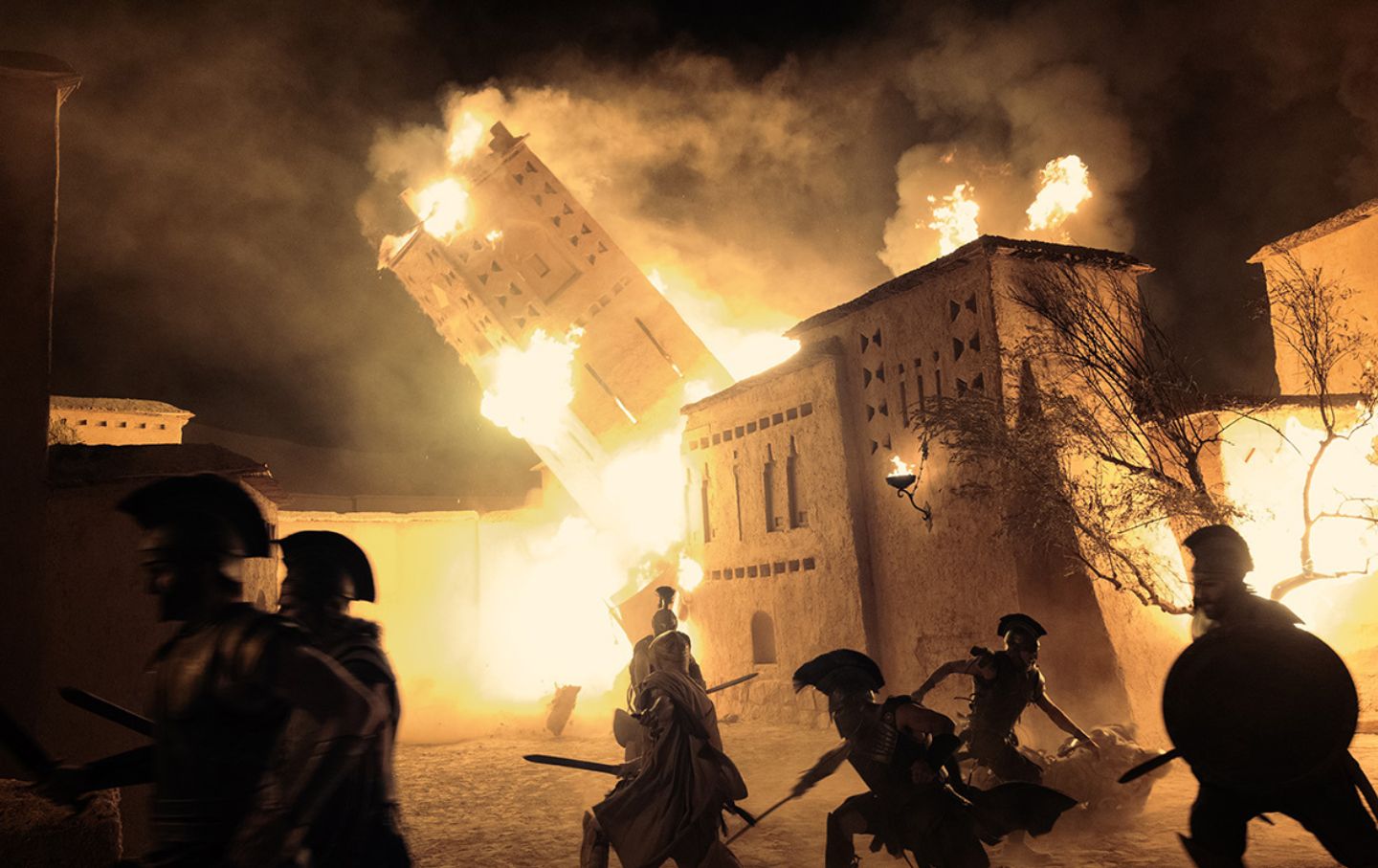
As the credits rolled at the end of The Odyssey, the Long Island cinema burst into applause. This struck me as strange: The hero had just confessed his guilt for the trick at Troy, disguising a weapon as a gift to the gods—a transgression that would lead to the collapse of his world. There seemed little cause for celebration. Was the audience cheering the hero’s victory over the bad guys, or were they taking a side in an ongoing culture war?
When Christopher Nolan adapted Homer’s epic to speak to a world where American power is being challenged in new ways, it was inevitable that it would provoke the right. Even before the film came out, the casting of Lupita Nyong’o as Helen launched a thousand tweets, and Elon Musk threatened to use Grok to make another version with ethnically Greek (though AI-generated) actors. But it’s not only the casting that made Nolan’s film controversial. It’s also, I think, a more general debate over the genre of epic.
Epics are long narrative poems telling of the most consequential acts by the most powerful people. Different ancient epics treat their protagonists in different ways, and they’re not always straightforwardly heroic. The Iliad tells of Greece’s victory in the semi-historical Trojan War; The Odyssey follows one of the victors, Odysseus, in his meandering return home. The great Latin epic, Virgil’s Aeneid, follows another Greek soldier, Aeneas, who later became the founder of Roman civilization; by contrast, Lucan’s epic, The Pharsalia, describes Caesar’s triumph in the Roman Civil War only to grotesquely ironize him.
In recent years, the online right has contested adaptations of epic in order to make an argument about masculinity. This was visible in the 2024 campaign against Emily Wilson’s translation of the Odyssey—which Nolan relied on at least in part for his writing of this film—which refers to its hero as “a complicated man.” This choice of words was contested by right-wing commentator Maxwell Meyer, who admitted to having had only one semester of Ancient Greek. Likewise, the podcaster Matt Walsh criticized Nolan’s Odysseus (Matt Damon) as “an anachronistic whiney solemn shell of a man.” Apparently abandoning his earlier plan, Elon Musk offered to fund another adaptation directed by Mel Gibson.
There are many valid criticisms to be made of Nolan’s film (as in the excellent review by Christian Lorentzen), but the decision to make the hero relatively unheroic has precedent in a long line of epics: Dante put Odysseus among the pagan heroes in the first circle of Hell. Shakespeare, who never wrote an epic poem, gave his tragic heroes an unrivalled psychological complexity. Milton’s Paradise Lost casts Satan as a figure of Odysseus-like cunning, and heroizes Adam and Eve’s struggle to accomplish the quieter virtues of humility, forgiveness, and love. Wordsworth’s The Prelude strays even further from martial valor, describing the development of an individual mind in moments of solitude and joy.
In America, epic has had a complicated history. Some years ago, I was teaching a class in a New Jersey prison and found that none of my students knew what “epic” meant. As I tried to define it, I thought of a huge flag I had seen towering over a highway in Washington, DC, taller than Satan’s spear in Paradise Lost, which Milton compares to the tallest Norwegian pine. One difficulty in explaining the genre was that so much about American culture is epic—the love of bigness, the deep respect for the military, the obsession with superhero movies—yet there wasn’t a single famous American epic poem to point to.
Current Issue

Since epic was considered a jewel in the crown of empire, numerous American poets tried and failed to write a good one. In 1787, after a French critic said the USA hadn’t produced a good poet, an insulted Thomas Jefferson said this would be a valid reproach only when the new nation had “existed as a people as long as the Greeks did before they produced a Homer, the Romans a Virgil, the French a Racine and Voltaire, the English a Shakespeare and Milton.” In short, after about 500–1,000 years. Jefferson wasn’t wrong: Over 400 years since the Mayflower, there have been many good American poets but not a single great epic.
That isn’t necessarily a bad thing. Walt Whitman’s Leaves of Grass is an extended lyric poem that attempts to encompass the whole cosmos in its egalitarian, if presumptuous embrace. Whitman declared the American people were “the greatest poem,” and one that didn’t need the outdated grandiosity of epic. Other American epics have been written since then, though the most obviously Homeric one, Derek Walcott’s Omeros, is from the Caribbean and celebrates a life of quiet survival.
These humble virtues have found a home in the bourgeois novel, which 20th-century critics like György Lukács argued had superseded epic. From Don Quixote onward, the great literary novels have rarely been straightforward celebrations of heroism: Vanity Fair, subtitled “A Novel Without A Hero,” describes the barbarity of the Napoleonic Wars; Moby-Dick is a delusional revenge quest; Middlemarch follows a provincial woman who might have lived an “epic life” if she hadn’t had to inhabit a domestic realm of “unhistoric acts”; James Joyce’s own Ulysses is about a long night of drinking.
As Joyce’s use of a Homer title suggests, epic has retained its cultural importance. In the 20th century, so many Hollywood films, from Citizen Kane to Titanic, flooded America with the epic tales that poets hadn’t been able to supply. This has not abated in our century, but the casting of heroes in video games, Marvel movies, and Disney franchises has increasingly been challenged by right-wing commentators. It was in this context that Jordan Peterson called Disney’s Frozen “dismal, wretched, and pure ideology.”
Right-wing commentators believe that fictional heroes should be admirable in order for men to imitate them, but films made along those lines are often kitsch, unrealistic, and unsatisfying. See, for example, John Aglialoro’s wooden three-part adaptation of Ayn Rand’s Atlas Shrugged, which failed to retain the same Aryan actors for each installment. Or war films like 12 Strong, which offer more idealized portraits of veterans than Homer, whose hero returns home and massacres the slave girls in a bloody frenzy.
If it seems odd to want a protagonist to be less complex than one Homer invented 3,000 years ago, parts of the online right have been trying to revive a pre-Homeric worldview. Their Bible is Costin Alamariu’s 2018 Bronze Age Mindset, a polemic that celebrates the prehistoric period (3300 BCE–1200 BCE) as one where Nietzschean supermen still roamed the shores of the Mediterranean. That time had already passed when Homer composed his poem, around the 8th century BCE. To revive the Bronze Age mindset, Alamariu advised making movies more heroic, declaring, “What Mel Gibson does is worth a thousand books.”
Popular
“swipe left below to view more authors”Swipe →
Meanwhile, a more communitarian section of the right values ancient epics because they see them as the symbol of a closed community with stable beliefs; the kind of place they want America to become. Whether Homer’s Greece was that stable is debatable, to say the least, but it’s an even more improbable ideal for a multicultural nation in a hyper-networked, multipolar world. Ironically, even as people like JD Vance propose to rebirth a more communitarian nation, his own government has undermined the Declaration of Independence—the closest thing the US has to a collectively held, memorized epic text.
When they cheered at the end of the film, the Long Island audience may have just been acknowledging the end of a blockbuster that had been more serious and edifying than the usual summer fare. As Emily Wilson pointed out in her review of The Odyssey, sales of Homer translations have soared in recent weeks. This is no bad thing in a nation where 40–50 percent of adults no longer read a single book per year.
The revival of interest in epic can do more than fuel a tedious culture war. Epics should encourage us to think more deeply and expansively: As Aristotle said, they are stories about the most consequential human actions. This aspect of the genre doesn’t require the powerful to be admirable, nor ordinary people abject. Shakespeare adapted Homer’s story for Troilus and Cressida, a play about a world made cynical by war. None of its characters are heroic.
More from The Nation
The world inside the South African novelist’s Waiting for the Barbarians bears striking resemblance to Trump’s racist empire.
The big-budget movie keeps much of the violence and spectacle but none of the nuance and wit of the classical epic.

In The Cultural Marxism Conspiracy, A.J.A. Woods looks at how the Frankfurt scholars became the latest bogeymen for the contemporary right.
