


Updated ,first published
Ankara: President Donald Trump said on Wednesday that the US was preparing for another night of strikes against Iran, just hours after he said the ceasefire was over following Iranian attacks on American military sites in the Gulf.
“We hit them very hard last night,” Trump said when asked about a possible return to hostilities. “We’ll probably hit them hard again tonight.”
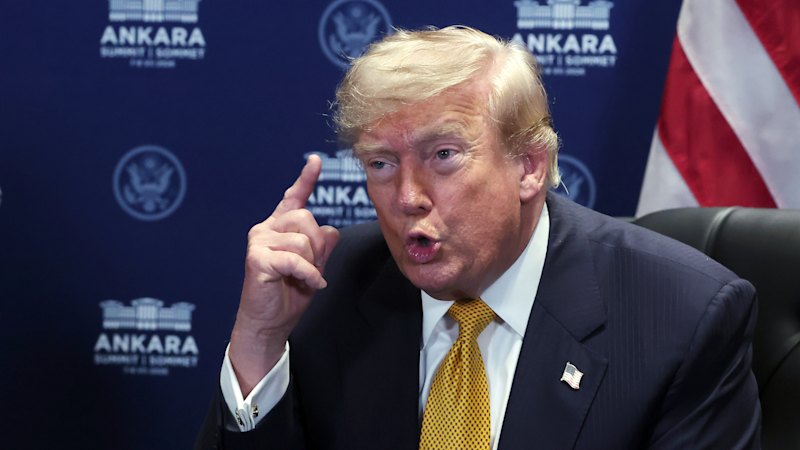
Trump made the remark in Ankara, Turkey, on the sidelines of a NATO summit. He said the strikes are continued retaliation for Iranian attacks on commercial ships in the Strait of Hormuz.
“They are behaving very badly,” he said of Iran, accusing the country of launching drones and a missile at ships.
The latest exchange of fire raised fears that the war in Iran could reignite, and Trump fuelled those concerns by saying the interim agreement to pause fighting was “over,” although he added that he would allow negotiations to continue.
“I don’t know if we’re going to have a deal. We may just do it without a deal,” he said.
Earlier, Trump told reporters: “I don’t want to deal with them any more; they’re scum”, adding that negotiators could continue talking but were “wasting their time”.
His remarks came as Iran’s Revolutionary Guards targeted American military sites in Bahrain and Kuwait on Wednesday after the US launched a fresh wave of strikes on Iran in response to attacks on tankers in the Strait of Hormuz.
In the latest blow to the fragile truce, the Revolutionary Guards said it carried out a joint missile and drone operation against US bases in Bandar Salman, Bahrain’s Fifth Naval District and Ali Al Salem Air Base in Kuwait, and shot down a US MQ-9 drone attempting to interfere with the operation.
Air raid sirens sounded repeatedly in Bahrain and Kuwait, and the Kuwaiti Army said air defences were confronting missile and drone attacks. There was no immediate comment from the US military on the strikes.
The US struck over 80 targets in Iran and revoked a licence allowing Tehran to sell oil, in response to attacks on three tankers in the strait.
US Central Command (Centcom) said more than 60 Revolutionary Guards’ small boats were among the targets hit during the operation, which was intended to impose a heavy cost on Iran for strikes on shipping in violation of the ceasefire.
“The unwarranted aggression by Iranian forces is a clear and dangerous violation of the ceasefire and undermines freedom of navigation,” Centcom said in a statement.
‘Flagrant violation’
Addressing a question from a reporter at the NATO summit on whether the interim deal, or memorandum of understanding, agreed with Iran last month was dead, Trump replied: “It’s a very interesting question. To me, I think it’s over.”
“They’re sick people. They’re led by sick people. And they’re vicious, violent people.
“And if they had a nuclear weapon, they’d use it. As far as I’m concerned it’s over.”
Trump said talks with Iran could continue, but that he was very sceptical they would be productive.
Earlier, Iran’s Foreign Minister Abbas Araghchi said the latest US strikes, together with the renewed oil sanctions and Israel’s ongoing war against Hezbollah in Lebanon, amounted to a “flagrant violation” of the agreement.
He said Iran “will not hesitate” to defend its “integrity, national sovereignty, and national security” and warned Gulf countries hosting US bases that Iran would “target the source and point of origin” of any attacks.
Ahead of the Ankara summit, NATO Secretary-General Mark Rutte said the latest US strikes were “absolutely necessary”.
“When you have a ceasefire and Iran is basically violating the ceasefire, I think it is totally crucial that the US forcefully react,” Rutte told reporters.
Iran’s top joint military command, Khatam al-Anbiya Central Headquarters, condemned the attacks as a blatant act of aggression, threatened a “crushing response”, and warned that Tehran would not allow US interference in the management of the strait.
A US official on Wednesday said the strikes had targeted Iranian air defence systems, coastal surveillance systems, surface-to-air missiles, anti-ship cruise missiles and drone launch sites.
Iranian media reported explosions in Iran’s main oil hub, Kharg Island, on Qeshm Island, and in the southern port cities of Sirik and Bandar Abbas.
Several blasts were heard on southern Kharg Island, Iran’s Press TV reported. Centcom made no mention of Kharg Island, from which Iran exports 90 per cent of its crude oil.
No civilian deaths were reported, but several people were injured by shrapnel from an “enemy projectile” that hit a commercial pier in Sirik, according to an Iranian state TV reporter. The reports said strikes also hit fishing piers in Sirik and in Bandar Abbas.
Oil prices rise
On Tuesday (US time), Washington moved to withdraw a key concession that had allowed Iran to sell oil on international markets.
Oil prices rose more than 3 per cent after the US announced the move.
An American official said earlier that negotiators continued to work in good faith towards a final agreement with Iran. But control of the strait has given Tehran immense leverage, effectively allowing it to force a stalemate with the world’s most powerful military.
Analysts say Tehran uses attacks on ships to underscore that leverage as it negotiates a long-term peace deal.
Under the interim agreement, the US Treasury issued a June 22 general licence allowing the sale of crude oil, petrochemicals, and petroleum products of Iranian origin until August 21.
In revoking that licence on Tuesday, it gave Iran until July 17 to wind down any transactions.
Iran blamed for ship attacks
While Tehran denied responsibility for the latest strikes on ships, Qatar blamed Iran for attacking the vessels, including the huge Qatari liquefied natural gas tanker Al Rekayyat, which reported being struck by a drone that caused a fire in its engine room. The crew were safe and being evacuated.
A Saudi-flagged crude oil tanker, believed to be the supertanker Wedyan, was also damaged off Oman, maritime security sources said. The cause was not immediately clear.
Iran’s Foreign Ministry said Qatar’s accusations were perplexing and Tehran was diligently fulfilling its commitments. Even so, it said commercial vessels faced risks for using routes not co-ordinated with Iran.
A second US official, speaking on condition of anonymity, said initial indications were that Iran had fired at three commercial vessels.
Iran’s clerical rulers aim to install a permanent system to collect fees in what would amount to a huge shift of the balance of power in a region where Washington has long acted as guarantor of security.
The US strikes came after huge crowds mourned Iran’s late supreme leader Ayatollah Ali Khamenei in the holy city of Qom. Khamenei was killed with his daughter, granddaughter, son-in-law and daughter-in-law on the war’s first day.
The ceasefire was intended to provide a 60-day window for negotiations on a permanent agreement, but indirect talks in Qatar ended last week with no sign of progress.
