



Updated ,first published
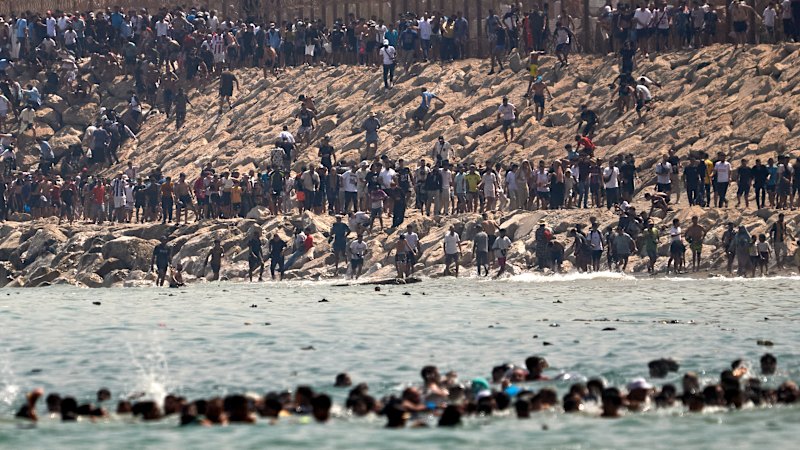
Thousands of migrants have rushed across the border from Morocco into the Spanish enclave of Ceuta in a startling move that was relayed on social media and triggered a political row about migration into Europe.
One security official declared the border checkpoint had “totally collapsed” under pressure from the crowd, as young men spread instructions on social media on how to enter the Spanish territory on the northern coast of Africa.
At least 34 people died attempting to enter the territory, authorities said.
Some migrants swam from Moroccan territory to reach the city, while others walked around a breakwater and crossed the rocks in numbers that overwhelmed authorities.
Spanish state television TVE initially said 2000 to 3000 people had crossed, but Reuters later reported the Interior Ministry had estimated that figure was about 49,000 in the past 24 hours. Spanish newspaper El Pais also put the number at more than 40,000, while Mayor-President of Ceuta Juan Jesús Vivas told journalists it was about 60,000 – an extraordinary figure given the territory’s population is around 85,000 people.
In Fnideq, a Moroccan town just beyond the Ceuta border, Moroccan authorities aimed water cannons at migrants very late on Thursday in an attempt to deter them from crossing, witnesses told Reuters.
“It was very tough. The police tried to stop us. But our will and determination allowed us to come here,” migrant Jadid Zacaria, his hair and shirt still wet from the ocean, said in an interview in Ceuta on Thursday afternoon as migrants streamed through a border gate nearby.
On a highway 150 kilometres south of Ceuta in Morocco, Reuters witnesses saw groups of young people walking north in hopes of reaching Spanish territory.
In Melilla, Spain’s second autonomous city in northern Africa, footage from local media and human rights organisations appeared to show clashes at the Beni Ansar border point late on Thursday. That has been the only open crossing between Morocco and Melilla for the past six years.
Melilla and Ceuta have the European Union’s only land borders with Africa.
According to Omar Naji of the Moroccan Association for Human Rights, at least three vehicles were set ablaze and injuries were reported among migrants and security forces. Morocco’s Interior Ministry did not respond to requests for comment.
Spanish Prime Minister Pedro Sanchez promised an “immediate response” to the situation in Ceuta, but the crisis sparked angry warnings from the Italian government about rules set in Madrid that allowed people to seek asylum in Spain and gain work rights in the EU.
“We are mobilising all necessary resources, working with Moroccan and international authorities, and preparing the necessary measures to restore normalcy as soon as possible,” Sanchez said.
Spain’s government later said it would send the military to help the Civil Guard to maintain security in the city of Ceuta. It was not known whether reinforcements were being sent to Melilla.
Still, it appeared to be too little to quell concern in other countries about a breach of European borders.
The political impact reached far beyond Spain because of the debate across Europe about migration, with British right-wing leader Nigel Farage sharing the dramatic videos online. “It’s time to wake up everybody,” Farage declared.
Italian Prime Minister Giorgia Meloni called for urgent action and warned that her government might suspend an open-border passport agreement with Spain if the situation was not brought under control.
“The images coming from Ceuta are striking and demonstrate, once again, that uncontrolled illegal immigration poses a concrete threat to the security of Europe’s borders,” she said.
“Italy will not stand by and watch. We are convening the relevant bodies, and following these meetings, we are prepared to intervene with extraordinary measures to defend the borders and the safety of citizens, including the suspension of the Schengen [free-travel] area with Spain.”
Italian Foreign Minister Antonio Tajani backed this approach and was sharply critical of the Spanish government’s decision to accept asylum seekers.
“Irregular and uncontrolled immigration poses a danger to national security,” he said.
“The images coming from Ceuta show how the Madrid government’s decision to grant Spanish, and therefore European, citizenship to over 500,000 irregular immigrants is profoundly wrong and encourages human trafficking.”
That drew a sharp response from Spanish Foreign Minister José Manuel Albares, who summoned the Italian ambassador to a meeting in Madrid because of the message from Rome.
“This message is unbecoming of the foreign minister of a partner and friendly country from which we expect European solidarity and not partisan demagoguery,” Albares said.
Former French prime minister Michel Barnier joined the argument by calling for the EU to enforce tougher rules to send back illegal migrants.
“France cannot bear the consequences of the migration policies of its neighbours. If a member state makes decisions that create a pull factor for irregular migration, we must be able to protect our borders immediately, particularly with Spain,” he said. “Controlling immigration is a prerequisite for sovereignty, security, and trust between European states.”
Spain’s El Pais newspaper reported that Civil Guard officers had to open the gates because they needed to prevent a bottleneck forming at the checkpoint.
Why are people fleeing Morocco?
The rush follows a Supreme Court decision in Spain last month that prevents migrants who are intercepted at sea while seeking to get to Ceuta from being immediately returned to Morocco.
That ruling is being blamed by some politicians for giving Moroccans an incentive to swim to Ceuta, a distance of about 2 kilometres across the water, or walk around the breakwater.
Another source of debate is the Sanchez government’s decision this year to grant amnesty to migrants already in the country, leading to more than 1.3 million people applying to remain permanently.
Ceuta, located roughly opposite Gibraltar in the western Mediterranean, has been a Spanish territory since 1580 and now has the status of an autonomous city of Spain, although it is surrounded by Moroccan territory.
Rachid Sbihi, the head of the association that represents the Spanish Civil Guard officers in Ceuta, called for a national emergency to be declared in Madrid to stop the mass movement because the border had totally collapsed.
“The situation is absolute chaos,” he said. “It’s not possible to give precise numbers, but there are thousands of migrants crossing.”
The Ministry of the Interior in Madrid has pushed back at the idea of a national emergency being declared.
Interior Minister Fernando Grande-Marlaska is due to travel to Ceuta on Friday.
Ceuta’s mayor-president said the influx had overwhelmed the city’s reception system and left hundreds of migrants sleeping outside.
“We are facing a situation of absolute humanitarian and social emergency,” Vivas told radio station Cadena SER, adding that facilities for unaccompanied minors were operating at 2400 per cent of capacity.
In comments to radio station Onda Cero, he described the situation as a national emergency and called for a “decisive, forceful, immediate and co-ordinated” response under a single command structure.
Vivas also pointed to the human cost of the crossings, saying 60 bodies had been recovered at sea in recent months, and argued that stronger migration controls would help prevent further deaths.
With AP, Reuters
Get a note directly from our foreign correspondents on what’s making headlines around the world. Sign up for our weekly What in the World newsletter.
 David Crowe is Europe correspondent for The Sydney Morning Herald and The Age.Connect via X or email.